Showing posts with label home/school connections. Show all posts

Friday, February 7, 2014

In February Peine Ridge Elementary shows Love to the Ronald McDonald House Charities of Greater St. Louis


When you think of McDonald’s you may think of a quick way to grab dinner on a busy night while running your children around to their various activities.  But there is another side to McDonald’s you hopefully do not know about.  It is the part of the corporation that runs the Ronald McDonald Houses and Family Rooms at area children’s hospitals.  Maybe you have had to use these services for your child, maybe you know a friend or family member who has had to use those services, or maybe you are fortunate and have never even thought about the Ronald McDonald Houses and Family Rooms.  Last year, we at Peine Ridge all became familiar with the comfort and support provided by the Ronald McDonald House Charity of Greater St. Louis.  One of our own teachers, Mrs. Youngberg found that she needed the services when her son Easton was born with multiple medical needs.  She has graciously offered to share her story and  explain why we are raising donations for RMHC this February.
 As you may or may not know, my second son-Easton, was born this past April with many medical conditions (‘like’ his Facebook page, called “Easton’s Journey” for more information). Due to his needs we've spent numerous hours, days, and weeks at St. Louis Children’s hospital-where there is a Ronald McDonald Family Room. The Ronald McDonald room was especially helpful in the beginning days when Easton was first transferred to the hospital. We weren't prepared to be staying the night in the hospital and our resources were limited because with Easton in the NICU he didn’t have his own room. Being able to take a shower in the Ronald Room was more comforting (and cleaner) than using the common floor’s parent lounge shower and being able to do laundry if needed was another “like home” commodity. But probably the most comforting thing about the Ronald McDonald Family Room was the fact that we could briefly “get away” from the stress of the hospital and take a few moments for ourselves. Walking in to a smiling volunteer, a freshly baked cookie, free snacks & drinks,  a computer to use, a private room, or games to play with Caden (our 3 year old): all of these things and more is what, now looking back, helped to turn a stressful and worrisome situation a little more calm and comforting.  
Some supplies that, in my opinion, are used the most: 
  • travel size shampoo/conditioner,
  •  travel size body soap, 
  • travel size toothpaste,
  •  toothbrushes, 
  • travel size deodorant,
  •  disposable razors, 
  • laundry detergent any kind -(Dreft for the NICU babies!), 
  • dishwasher detergent,
  •  individual packaged snacks (kid friendly ones too),
  •  simple & easy-to-cook meals (easy mac, Ramen noodles, soups),
  •  individual snacks, 
  • disinfectant wipe
  •  coloring books & crayons, 
  • simple games for children

We will be collecting supplies to support the Ronald McDonald Houses and Family Rooms in St. Louis throughout the month of February.  

We will send you weekly updates and lists with needed supplies, how much we have collected and how we are using this project for Character Development with the students.  Peine Ridge is a family, a community, and a support system for all of those who live, work, or attends school in our community.  Thank you for supporting our efforts this February.  For more information about RMHC go to http://www.rmhcstl.com/ for stories and expanded wish lists.

This sweet little man is Easton and his smile will brighten anyone's day.  Please help support the Ronald McDonald House Charities by donating to the Peine Ridge Elementary Community Service Project.  RMHC took care of mom and dad while they took care of me me!  Thank you.  


To learn more about the Ronald McDonald House Charities of Greater St. Louis watch this short video clip of how your donations help St. Louis families of critically ill children.


Thursday, January 23, 2014

Science to do at home on a snow day!

Here is a little science experiment you can do at home when school is cancelled for snow or wind chill. You can use this to help explain glacier melting, the Arctic, the three states of matter (solid, liquid and gas) and how applying salt to the roads helps to melt the ice.  You can also show how melting ice causes rivers and rivers can erode the ground and make valleys and canyons (like the Grand Canyon).  You can pull in videos from National Geographic Kids and Discover Kids to help them understand these concepts.  You can work in some geography work by showing maps on Google Earth and other sources to show where glaciers and canyons/lakes (like the Great Lakes) are caused by glaciers.

Unfortunately the weather forecast calls for much more cold and snow for the rest of the weather so families, you will be (and always have been) their first and most important teacher.  Reading, doing science and writing about what they are doing when not in school will keep them from losing valuable skills they learn at school.  We may have many more "snow days" and the students will need to keep learning at home during these breaks.  We, the Kindergarten Team, greatly appreciate your time and support in working with you children at home to make sure they don't lose skills and continuing learning even during snow days.  We promise, they will love this experiment and will be glad to step away from the TV and video games to do this activity and other we will post.  Enjoy this post and we hope it helps you make the most of these snow days!

Take balloon and fill with water.  Place outside or in freezer.

Take out of freezer or bring in from outside and shake to see if frozen.  You can either make a solid ice ball or you can make and ice bowel if you don't want to wait for the entire thing to freeze.

Ice Bowl.  Explore it, hold it up to the light, touch it and write about what you see.  Document your observations or draw what you see.


Ms. Berghoff (Ms. Arrendale's Buddy Classroom Teacher) mixes up some food coloring and water in primary colors to use on the ice ball.  You can talk about primary and secondary colors and use the ice to mix the colors.  You can also use Liquid Watercolors (which do not stain like food coloring) to do this project for more brilliant colors.

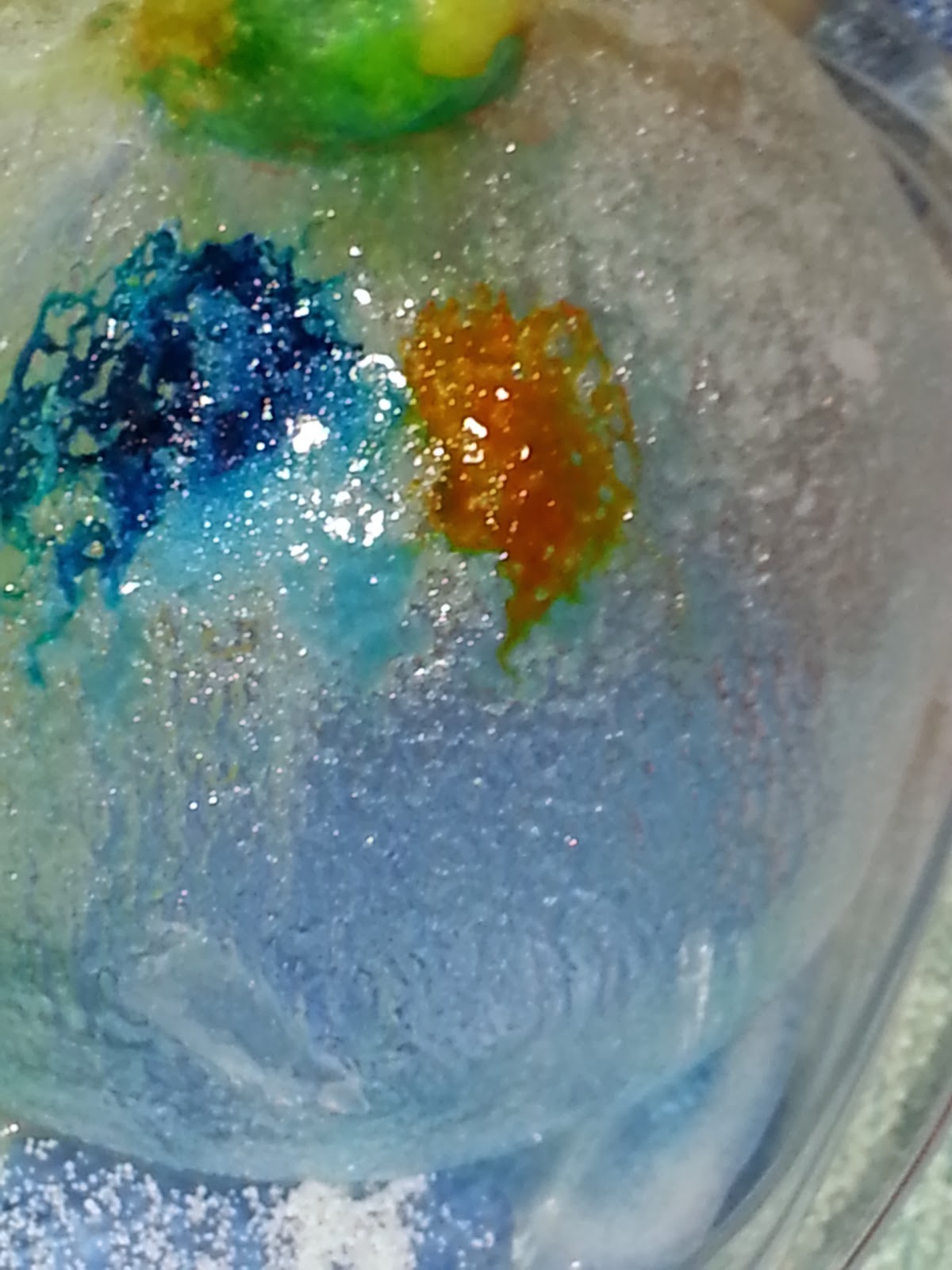
You can use eye dropper (best) or spoons to put colored water on the ice ball.  Do this without any salt on the ice ball.

Next, sprinkle salt (table salt) on the ice ball.  Observe what happens.  Listen!  Ours crackled and we started seeing cracks in the ice.  Ask questions!  Document what you observe.

Start dripping colored water on top of the salted ice ball.

Drop a few drops of food coloring directly onto the ice.  Observe what happens.  Is the ice changing?  Does the food coloring help you see any of the chemical reactions that are happening?


Continue spooning on colored water.  Keep a careful eye on any changes in the ice.

Take pictures or draw (with color) what you see happening to the ice ball.

Hold the ice ball up to the light (adults should do this, the salt and ice are very cold and could "burn" their little fingers, or have them wear gloves if they are going to hold the ice ball up to the light).  In a solid ball you will start to see tunnels forming into the ice ball.  The colored water helps to highlight those tunnels.

Add more salt from time to time.  Get a magnifying glass and really look at the ice ball.  Document more of what you see.  Take close up pictures!

Look at the ice ball in the light.  Shine a flashlight through the ball.


Now you will start to see a lot of melting and other activity going on with the ice ball.  Talk about the water changing it's state from solid to liquid.  Water can change according to heat and cold.  If you are brave save all of the melted water to boil later.  Explain that the steam coming out of the pot is the gas state of water.

Ask if this could be considered art.  What makes something art?  Make an art piece inspired by the ice.


Really look at the tunnels and crevasses caused by the melting water.  Talk about how the water erodes the ice, water also erodes land and causes rivers, canyons and lakes.  Look up the Great Lakes and explain those were cause by massive ice sheets (glaciers) that moved across the land a long time ago and was so heavy it carved out the Great Lakes.  As the ice melted it filled up the Great Lakes just like the melted water from the ice ball is filling up the container the ice ball is sitting in while you do the experiment. 


Talk about how the ice ball changed from solid to liquid.  Have your child explain what they think is happening and why.  Explain the role of salt and why we use it to melt ice on the roads.  Write some more of your observations down.  Take more pictures.


We hope you enjoyed this little demonstration of a learning activity you can do at home with your child on a snow day.  Have fun with it.  We promise, your child wont even know they are learning, but make sure you tell them how impressed you are with their scientific knowledge!  They love to be called scientists!

Monday, December 2, 2013

The Elves have arrived!

The elves have arrived from the North Pole to the Kindergarten classes!  We were all so excited to see them today.  They will be keeping an eye on the students (and the teachers) for the next three weeks.  The elves will fly back to the North Pole each night between now and December 20th and report on each child's acts of kindness to Santa.  We are all working extra hard to be Safe, Responsible and Respectful!  We wanted you to meet each classes elf.  Here they are.  We are proud to introduce:


In Ms. Allen's class Jolly arrived this morning sitting on top of the wreath!


In Ms. Boatright's class Rosie arrived and showed her patriotic side by hanging out on the flag pole!


In Ms. D.'s class Chippy arrived but was still a little tired from the long flight and needed to rest.  The kids found her snuggled down in a tissue box bed resting!


In Ms. O.'s class Elfie arrived, but appeared to have snuck in the window and apparently got a little tangled up in the blinds!  Silly Elf!


In Ms. Arrendale's class Trinity arrived and made herself comfortable on Toosie Bear's lap!  She brought a letter from Santa and kept a close eye out on all of the wonderful students!
 

We are sure we are going to have lots of adventures to report while our elves are in our classrooms.  We know many of you have scout elves at your houses too!  Our elves told us that they might be bringing some winter weather back from the North Pole with them later this week.  Watch out!


Tuesday, November 12, 2013

October review - updates from the classrooms

We wanted to share with you a few things we loved to use teaching math, science, reading and writing units last month from each of our classrooms.  We hope this will help explain a few of the terms you hear the teachers and students use (such as "buttering our popcorn words").  Please enjoy this little review of our October Units and some of our favorite teaching tools from last October.

In Ms. D's class they really got into their math centers with October inspired counting activities.  This is a super cute and super easy way to make counting fun for your child.  All you need are some paper plates and some spider rings.  These are great to use any time of year!

Ms. D also made a quick and easy upper/lower case letter match.  You can find these cute cut outs at a teacher store, at the dollar store or you can make them yourself with construction paper.  The kids love it when their "work" is made into fun learning centers like this!

This idea helps the student learn one-to-one correspondence (knowing that the number symbol for 1 equals only one spider on the web and being able to do this for numbers one through ten).  We will be introducing teen numbers this month so the fall and Thanksgiving themed activities will be coming out during center time!
 
In Ms. Boatright's class the students demonstrated their understanding of the life cycle of pumpkins by creating this super cute pumpkin, flower, leaves and seed mobile.  They then decorated their classroom by hanging their science mobiles from the ceiling.  Ms. Boatright's room started looking like fall harvest!

This activity helped the students develop fine motor skills by cutting and gluing the mobile pieces.  They also had to problem solve how to sequence the order of the life cycle correctly.  This was very meaningful after our field trip to the pumpkin patch where they got to see the life cycle of the pumpkin in the garden.  The students had to follow multi-step directions, listen closely, understand vocabulary and look closely at  the first letter of the words to place them with the correct picture (the seed and the word SEED, the leaves and the word LEAVES, the flower and the word FLOWER and the pumpkin and the word PUMPKIN).  The students also got to cut out and create their own pumpkin recalling the different shapes pumpkins can be (oval or circle).
 
In Ms. Allen's class you can see how the students "butter" their popcorn words after they have learned them.  They add the yellow "butter" after they have practiced the words and found them in books and in their daily poetry which she places on sentence strips and places in the pocket chart.  The students use Wiki Stiks to find the popcorn word(s) of the week in the poem.  The students also started learning about word families in October.  You can see her "AT" family cat with the "AT" family words!  Ms. Allen has word family pictures for all of the word families the students will learn in kindergarten and they are placed around the classroom for the students to use during reading and writing workshop.

Ms. Allen also created this wonderful anchor chart for the students to support their learning in Writing Workshop.  "When you think you are done you have just begun" is something all of the teachers say when the students say they are finished with a book they are writing.  When they are writing at home refer to this chart and ask them the following questions: can you add more pictures/details to your book?,  can you add words to your book? (really a great way to practice popcorn words and to start sounding out words), OR if they are really done and have added details and words (if they can) ask them if they are ready to start a new book.
 
In Mrs. O's class they students spent October learning about their new reading super powers (this unit was taught in all of the Kindergarten classes).  Mrs. O made this super cool reading anchor chart showing the students how to use their new super reading powers.  They can think about the story, use their Eagle Eye to look at the pictures to figure out a tricky word, they can take a picture walk to think about what they story is about and try to think about words they can expect to see in the text, AND they can use their super reading finger to tap under each word one time to stay in place and on track in the text.  I bet you didn't know she was such a great artist!

This is Mrs. O's word wall.  Each classroom has one.  You can see that Mrs. O has added all of the popcorn words her students have learned so far this year.  She also has all of the color words they have learned up there.  The students are learning how to use the word wall during writing workshop to help them write pattern books.  The word wall will keep getting fuller and fuller as the students learn more and more words this year!
 
In Ms. Arrendale's class the students finally were able to explore the fall items brought back from the pumpkin patch field trip during their science time.  They were able to compare and contrast these fall fruits/vegetables to the pumpkin they carved.  They were able to estimate the number of seeds and graph fall items during math.

The students were taught how to use a magnifying glass to observe and study the inside of the pumpkins and other fruit/vegetables.  The children were encouraged to use descriptive words to explain what they were observing.  They also created an anchor chart using descriptive words to describe a pumpkin after they used the magnifying glass to study the pumpkin closely.

In Ms. Arrendale's class they students drew different types of Jack-O-Lantern faces using the basic shapes on write-on/wipe-off boards and voted on the face they wanted carved into the pumpkin.  This was the finished product using squares, semi-circles, triangles, ovals and rectangles.  The students also wrote about their trip to the pumpkin patch in writing workshop.
 
 
We hope this little glimpse into our daily classroom activities helps you facilitate conversations that will help reinforce skills they were exposed to during last months lessons.  We had a great time teaching all of our kindergarten kids last month!  Fall is a great time to expand on their math, language and science skills.  We will update you each month with a monthly classroom update post to keep you informed.  Now that you know how to "butter" your popcorn words get a yellow highlighter and have your child "butter" some popcorn words in magazines, newspapers and junk mail you receive at home.  It is a fun and meaningful way to practice those popcorn words!